Unburied Nuts from 19th July 2007: Cats over Borneo

on Wednesday, April 14, 2010

From time to time, I uncover an older post and give it another chance in the spotlight. As I am not very creative at the moment, I thought it was time to do so again. As it happens, there have been a lot of visitors sniffing around this post having Googled "cats over Borneo" or "cats and parachutes". What strange things people use Google for! Well, if you had done so, you might have ended up unearthing this fact is stranger than fiction story. Enjoy.

CATS OVER BORNEO

Cats in Cat City, Borneo (PhotoCredit: LGS)


This strange piece of public art is found in the city of Kuching which is the capital of the state of Sarawak on the vast, equatorial and forested island of Borneo. The cats' theme is actually in tribute to the city because the name Kuching actually means "cat" in the Malay language. Hence Kuching is actually "Cat City".

However, Borneo is the setting of an even more interesting and bizzare cat related story. This story is often called "Cats over Borneo". The story is set in the 1950's. Malaria, the severe and potentially fatal blood borne disease, was rampant and it was known to be spread by the Anopheles mosquito. The relatively new and young World Health Organization (WHO) was fervent in their efforts to fight malaria.

They had just added to their arsenal of weapons, a new and effective insecticide, a chemical called dichlorodiphenyltrichloroethane or DDT. Today, we are aware of DDT's problems including its long half life and tendency to accumulate in fatty tissue as well as its effect on non-target species. However, at that time, the pesticide was being used worldwide, and was widely touted for its safety and its effectiveness.

Anyway, the WHO sprayed DDT liberally in the Dayak villages of the Sarawak interior. Initially, this campaign was considered a success as mosquitoes were killed and the malaria rate dropped. Then authorities were hit by two mystery complaints. The first was very bizzare. The Dayak villages consisted of longhouses which accomodate several families and which were covered by a thatch roof. The villagers complained that their roofs were collapsing exposing whole communities to the elements. Although puzzled, the authorities were forced to act quickly and sent in corrugated metal sheets to be used as roofing material.

Before, they could even take a breather, they were surprised by the outbreak of plague and reports of famine as grain stores were decimated by a large invasion of rats. The authorities urgently investigated the matter and called the Royal Air Force for help. Citizens were also asked to donate cats and to help build special cat baskets. Operation "Cat Drop" was carried out in which hundreds of cats were parachuted by the RAF onto interior villages. This reinforcement of cats eventually solved the problem.

The Day They Parachuted Cats on Borneo by Charlotte Pomerantz relates this true story in the form of a rhyme. It is also featured in an article by Gordon R. Conway in The Careless Technology: Ecology and International Development (1972) and a first-hand account of “Operation Cat-drop” is given by Tom Harrisson in the journal Animals published in 1965.

What transpired in the jungles of Borneo is a clear example and a cautionary tale that man does not know enough about the inter-connectivity of the web of life and many of our actions to address a single problem have often unexpected reprecussions. The DDT did infact kill the mosquitoes and also other insects in the jungle which were non-target species. One of which was a jungle wasp. These wasps in turn played the important role of keeping a certain caterpillar population in check by laying eggs on the caterpillar and when the larvae hatch out, the larvae feed on the caterpillar, killing it. When the DDT killed the wasp, the caterpillar population boomed and as the caterpillar fed on the roof thatching, the roofs started to collapse.

At the same time, the geckos which are a type of lizard which feed on insects were having a great time because it kept finding dead insects everywhere. However, as they ate, the DDT levels in their bodies continued to rise. The cats in the village in turn often catch and eat the geckos. Soon, all the cats died of poisoning. With the cats gone, the rats came out to play. Their population boomed, leading to the destruction of grain stores and the spread of plague. A situation that was only reversed by the airborne drop of cats over Borneo.

A strange but true tale and a warning to man to stop messing with the world's complex and balanced web of life. I did not even mention how all these imported cats caused a great upset to the indigenous squirrel population!

Hot, Sweaty Men

on Tuesday, March 30, 2010

There are three posts in one.

Post No:1 Sensational Blogging


The Lone Grey Squirrel has succumbed to blatant sensationalism to attract more readers by pandering to the blogging demographics (overwhelmingly women) and has basically resorted to give them what they want.............HOT, SWEATY MEN.

It is a pity that cute, furry squirrels have not proved to be sufficient.

Anyway, all these pictures and the short video at the end were taken by the Lone Grey Squirrel for your viewing pleasure, ladies. The are all about a performance during an Earth Hour Event at a mall last Saturday night.


Post No: 2 Sensational Nature Documentaries

There were about 300 people gathered at this shopping mall open air atrium to observe Earth Hour. I am sure most of you know about Earth Hour but in case you don't , this event encourages people and cities around the world to switch off the lights for one hour. Switching off the lights for one hour barely makes a dent in our annual consumption of energy but the idea is to just raise awareness about the problem of climate change and our need to reduce our personal impact on the environment including our energy consumption. If those 300 people at the mall then just change their lifestyles to stop wasting energy and manage to reduce their energy consumption by even 10%, then that is what will make the difference that counts.

However, my thoughts drifted to the fact that the organisers had to organise a didgeridoo player, two clowns, one fire-eater, a whole troupe of hot sweaty men, a drum act, a band, two Malaysian celebrity singers and a choir from a children's home to get people to come for the event. They were all great but if we didn't have any of that, would the people have come just to sit in the darkness for one hour?

So regrettably, I note that people today need to be given eye and ear candy. It is not good enough just to support a good cause. The cause needs to also be entertaining.

I notice it is even true of once astute institutions like National Geographic or Discovery Channel. I grew up with nature and wildlife documentaries that introduced their viewers to the beauty of nature and animals while teaching a good respect for all things wild and promoting the common sense of keeping one's distance for the mutual benefit of wildlife and human viewer. Today, it is different. There seems to be a proliferation of documentaries that take great pride on how close the presenter can get to a snake or a crocodile without getting bitten.

In one recent documentary, the presenter takes a walk in a coastal forest at night and tells the viewers that the forest is a particularly dangerous place to be at night and that you would be foolish to come there at night.............and there he is walking there at night.

I did have a chance to talk to a film producer about this once and he said that the reality is that today, channels like Discovery, see their rivals as channels like HBO. In other words, documentaries are about entertainment first and education a distant second.

This is sad. We really have to draw the line somewhere and in my opinion, documentaries must first be about education.


Post No: 3 Sensational World
If you have made it down to this final post past all the sensational hot sweaty men, thank you. I have only one thing to say, "We do have a sensational world, let's keep it that way. Let us change our wasteful and selfish ways for Mother Earth."

A Fallen Light

on Friday, March 05, 2010

Taman Negara (LGS)

Oh Ancient Mother, who watches over our very heart beats,
See, O see your children's desperate plight
Our forest had grown dark, the light fails and retreats,
It seems like life itself had taken flight.
The land was bleeding earth into brown choked rivulets,

Oh Ancinet Guardian, protector of all living things
Hear, o hear your people's despairing cries,
The land ails and fails to provide as once it did,
The water, the air poisoned with lies
Our bellys are empty and our children beyond comforting.

Oh Ancient of Ancients, who dwells in all we know,
Feel, O feel your spirits dire impotence,
As spirits of steel and smoke surround and grow
And care not for keeping the natural balance
Our familiars, our guides are silent and cold.

Oh Ancient One, our hope as in the rising morn,
From amongst us you arose a special son,
Your child, my child and our hope and light reborn
Born to stand in the gap of dreams and reason
To lead our people back from past beyond

Oh Ancient One, joy again brightened our face,
Aha! Aha! Aha! The sweet melody rings,
No longer do we sell the future of our race
To fill bellys and for forgetfulness drinks
With heads held high facing newly bright days

O Mother of Mothers, who comforts and dries tears,
Know that our hearts, briefly warmed have grown cold.
For the light flickered and fell before his years,
He bore his people's hopes, the boy who was old,
O Mother of Mothers, comfort him and dry his tears.

Cold Day in Copenhagen / A Critically Warm Earth

on Sunday, December 20, 2009


Villager in Navua, Fiji, at his ancestral burial ground,
which is now covered by the sea at high tide due to rising sealevels.


I was forced to interrupt the planned regular program of posts which would have been on the on-going series about my trip to London to bring to you this important message:

WHAT WERE OUR WORLD LEADERS THINKING?!?!?!

It was a cold, cold day in Copenhagen when the recent Conference of Parties on Climate Change ended with no binding agreement on how to reduce the global levels of greenhouse gases. Leaders from some 190 countries met but failed to put the needs of the world first before selfish individual nationalistic aspirations.

There was no binding agreement to reduce levels of greenhouse gases effectively and there was no agreement to provide the USD 300 billion already believed to be needed to counter the effect of climate change and to equip the poorer countries to be part of the solution.

Cosmologist and mathematician Stephen W. Hawking said global warming has eclipsed other threats to the planet, such as terrorism. "Terror only kills hundreds or thousands of people," Hawking said. "Global warming could kill millions. We should have a war on global warming rather than the war on terror."

But it seems all the world leaders are unable to play fair and work together to solve the climate change problems. Several images come to mind.

Image 1: "All the world's leaders and all the kings couldn't put the world back together again" (with apologies to Humpty Dumpty )

Image 2: "Our leaders fiddled with numbers while the world burned" (with no apologies to Nero)

Image 3: "Let's not scare the people and ruin our economy" (with no apologies to all the villainous, bureaucrats/mayors/leaders from Hollywood disaster movies like Jaws and others where they ignore the warning of scientists).

Let's tell our leaders that we don't want this sort of "business as usual" leadership. We truly need someone to come and rise up to this emergency and we all need to support them.

Climate Change is already going to cause death, suffering and economic lost. We need action and not more hot air from self serving politicians.

In to Africa

on Saturday, August 22, 2009

For a very, very long time, one of the things that Ive dreamed of doing is to go on safari amidst the huge animal herds and carnivores of the African plains. One such place that you might do that is at Kruger National Park in South Africa.

In 2004, I had the opportunity to attend a conference in Durban, South Africa and I had hoped to make this dream come through. However, as it turned out, a trip to Kruger was a little too costly for my means nor did I have sufficient free time to make the trip.

Instead, I went with some others to one of the many independent and privately owned safari parks. These were essentially large areas of relatively open habitats but which were basically fenced off private property. The animals in these safari parks are 'managed", not free ranging and are often bought from other parks.

So really, they are more like open air zoos rather than truly natural habitats. The number of animals are usually quite low and they are often not prime specimens due to excessive in-breeding. So though I am grateful to have had the chance of even visiting a safari park, I still hope to do a real safari experience in Kruger National Park one day.

This is the jeep that we used to make our way around the park.


Most people come to see the big five which are the lion, leopard, rhino, elephant and Cape Buffalo. Well, I saw no lions or leopards (often missing from these safari parks as the predators are much harder to manage and costly to feed). Nor did I see any elephants but I did get to see the following; Cape Buffalo and the rhinocerous.


I also saw the giraffe. Now that is a big animal! I wonder why it is not listed as one of the top five.


I also saw a rather scruffy pack of ostriches.


But for me, the real jewel for my visit, was the glimpse of the secretary bird (Sagittarius serpentarius). This bird was so named because it is said to resemble a pompous British Government Secretary from the late 18th Century. It is a diurnal raptor and is seen on the coat of arms of the Republic of South Africa.


The apparent fading stripes on the rump of this Zebra is a sign of excessive inbreeding within the Zebra herd in this particular safari park.

Grey Alert!

on Saturday, June 06, 2009

Grey Squirrels are cute and innocent victims.

Mad dogs and English Princes! I can't believe my ears. It seems bonnie Prince Charles has called for the culling of my Grey Squirrel brethren throughout the British isles. Our crime for which we have been singled out includes;

a) Damaging hardwood trees by peeling their bark and
b) Out-competing the local red squirrels.

This is outrageous! I have always had a soft spot for the Prince seeing as he has had to cope with a lot of public attention while still having been made to wait so long to take his turn as monarch of the realm. But this incident has made me wonder if all that waiting has not in fact resulting in him having a soft spot in his head! What he is proposing is nothing less than racial discrimination against the Greys and the squirrel equivalent of ETHNIC CLEANSING!

First let me deal with the allegation that Greys are a threat to the Hardwood trees. Yes, it is true that Greys sometimes strip the bark off hardwood trees but this is something Reds do as well. Greys should not be singled out for this problem. Getting rid of Greys will not stop damage to these trees unless you also get rid of the Reds. However, one should look at the big picture and realise that Greys deserve a little reward because of the services they provide to the forest overall. It has been conclusively shown in their native habitat, eastern grey squirrels play an important role in forest regeneration. Buried but unretrieved nuts will often germinate, helping with reforestation. So, Greys in fact know more about taking care of forests than you humans! So let us get on with it.

As for outcompeting the Reds, Greys are charged with being larger, more aggresive, reproducing more effectively, nudging the Reds out of their habitats and spreading the Poxvirus which have killed up to 80% of the Red populations in some parts of the country but to which the Greys are immune. And so, the arguement goes, the Greys must be exterminated to save the Reds.

Let's see how this scenario compares with one from human history. I speak specifically of the arrival of the Palefaces in the New World. The Palefaces were larger, more aggressive (guns versus bows and arrows), had larger and larger numbers coming over, made treaties and broke them to push the "Red Indians" or Native americans out of their traditional lands and introduced the Smallpox virus which contributed to the decline of the Red Indian population from about 18 million before the arrival of the Palefaces to just over 500,000 at the start of the twentieth century. Now these same Palefaces from the motherland want to kill Grey Squirrels to protect the native Red Squirrels? What hypocricy!

If only, someone could have organised the culling of the Palefaces back then to protect the Native Americans, it would indeed be a fairer world. But there is one more important distinction. While the Palefaces came to the New World on purpose, the Grey Squirrels did not choose to come to the wet and rainy British Isles but were introduced there last century by the same Palefaces. So don't take it out on us Greys. Go see them forktongued Palefaces.

Now that the Greys are here (through no fault of our own), it is only right to live and let live. Instead of culling and inflicting such pain and suffering, by all means give us Greys contraceptives to control our numbers, set up reserves on islands to protect the wimpy Reds and we will even let you use our genes to help develop immunity for the Reds for the poxvirus.

Finally, do you really want to explain to your kids why you are war criminal for carrying out ethnic cleansing? Especially when us Greys are so cute? Take action now! Write to your MP. Protest in front of the British Embassies. Today, it is the Greys.......tomorrow it could be you!

Since Prince Charles has put his foot in his mouth with this outrageous statement of his, I feel it is only fair to end by having a little laugh at His Royal Highness expense. Enjoy.

Tragedy on the Slopes

on Sunday, December 07, 2008

Malaysia has suffered three major landslides in the last week. The first was a landslide that killed two young sisters in their sleep and damaged a couple of houses. Then on Thursday, there was a spectacular landslide affecting the car park of a major bank located in a posh commercial district of Kuala Lumpur. In this incident, no one was killed but 11 cars were seriously damaged or destroyed. Casualties and deaths may have occurred if the landslide was just 15 minutes later when a lot of workers would have finished work for the day and would have been in the car park on their way home. Finally, just this Saturday morning at about 4 in the morning, a large part of the hillslope at Bukit Antarabangsa just gave way, sweeping as much as 14 houses on its lower slopes. This time, as many as 4 have died and some are still missing. This latest incident is just a stone throw away from the site of the Highland Towers tragedy of 1993 when a highrise condominium came crashing down due to a landslide and killed 48.

Heavy rain was a major factor. The monsoon rains in Malaysia used to be light to moderate heavy but could continue for a few days. Today due to global warming and local changes in the micro-climate, we seem to be experiencing shorter but far more heavy and violent downpours.

The second factor has been the continued building on unstable and steep hillslopes and hilltops despite numerous calls, promises and directions from politicians to stop allowing those types of developments in the wake of previous landslide tragedies. After yesterday's landslide, the Prime Minister again called for no more developments on risky hillslopes. Will this time be different? Will we learn our lesson or forget it within a week and return to business as usual?

This series of incidences also hit close to home. If you look at the first photo below and specifically at the half-buried car on the left.......... well, my wife had parked our car just one parking lot to the left and in front. God was gracious and I got away with nothing more than a mud covered car, a broken tail-light and a very excited wife. But 11 cars were either seriously damaged or destroyed.

I do hope that this latest in a string of landslide tragedies will finally put a stop to developments on unstable and steep slopes. Unfortunately, many Malaysians would consider me an optimist rather than a realist cause they have seen this too many times before.

Landslide in Bank Parking Lot


Closer view of damaged cars


Major landslide in Bukit Antarabangsa


Houses damaged in Landslide.

All Photos by The Star Online

Real Life Award

on Wednesday, November 26, 2008

Reception after the Ceremony (Photo by LGS)

Monday the 24th of November 2008 was a very special night for me. Although I have generally avoided talking about my work on this blog, I feel the need to mark this occasion.

At a very special function, which was held at the base of the famous KLCC Twin Towers and which was attended and presided over by the Prime Minister of my country, awards were given out under several categories for outstanding contributions to the country. This was a new national award that was launched last year in conjunction with the 50th year of Independence. The very first inaugural award recipients were named at this function.

There were 5 categories. The first for Community and Education was won by a well known scholar who studied poverty and influenced the development of the country's education system. Another category was for Science and Technology and that was jointly won by a) the medical research team that risked their lives during a fatal disease outbreak which led to them discovering a new disease and b) to a doctor,researcher and lecturer who has greatly influenced diabetes research and treatment in the country. The award for Economic Contributions was given to a gentleman who discovered the way to greatly increase the yield and profitability of the oil palm crop which became a major source of income for the country. There was no award winner this year for the category for Scholastic Achievement.

The final category was for the Environment and it was awarded to the organisation that I work for. I was one of 10 representatives and supporters that were invited to receive the award on behalf of the organisation. It was a great experience. The award recognised the persistent effort of the organisation for more than 14 years which eventually led to the protection of a very large tract of wilderness forest. The award clearly belongs also to all the volunteers and partners that helped along the way.

Standing with all the other award recipients was very memorable as I have a deep respect for all of them (and especially for the medical research team) and therefore felt incredibly blessed to be counted amongst them. The award comes with a RM500,000 cash prize which will be a great help to us as we continue to try to get adjacent forests protected as well. But for me, it has been by far a most welcome encouragement to myself and to all the staff and volunteers that have given their hearts to the cause of conservation of our country's natural heritage.

I had a ball. I am now a little hung-over from the post-adrenaline rush. But the work must now go on. Nose back on the grindstone!

Alas, We Barely Knew You......

on Thursday, September 04, 2008

Even as the already high rate of species extinction is likely to accelerate with global warming (see previous post), new species continue to be discovered. This shows that we do not know enough about the plants and animals in our world and many are disappearing before we even learn about them. So when new species are discovered, I cheer for the discovery but eventually I get bummed by the thought of species loss. Still, I hope these two recent discoveries will be of interest to you.


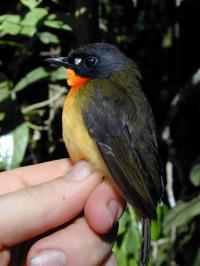
THE OLIVE-BACKED FOREST ROBIN

Scientists at the Smithsonian Institution have discovered a new
species of bird in Gabon, Africa, that was, until now, unknown to the
scientific community. Their findings were published in the
international science journal Zootaxa today, Aug. 15.


The newly found olive-backed forest robin (Stiphrornis pyrrholaemus)
was named by the scientists for its distinctive olive back and rump.
Adult birds measure 4.5 inches in length and average 18 grams in
weight. Males exhibit a fiery orange throat and breast, yellow belly,
olive back and black feathers on the head. Fem
ales are similar, but
less vibrant. Both sexes have a distinctive white dot on their face in
front of each eye.

PLEASE read the entire article at EurekAlert!


WORLD'S SMALLEST SNAKE

Excerpt from BBC News:

By Jennifer Carpenter

Science reporter, BBC News


The world’s smallest snake, averaging just 10cm (4 inches) and
as thin as a spaghetti noodle, has been discovered on the Caribbean
island of Barbados.


The snake, found beneath a rock in a tiny fragment of threatened
forest, is thought to be at the very limit of how small a snake can
evolve to be.


Females produce only a single, massive egg - and the young hatch at half of their adult body weight.


This new discovery is described in the journal Zootaxa.


The snake - named Leptotyphlops carlae - is the smallest of
the 3,100 known snake species and was uncovered by Dr Blair Hedges, a
biologist from Penn State University, US.


Read the full article at BBC News online.


Melting Point

on Tuesday, September 02, 2008

The Doomsday Clock must surely be clicking towards midnight. This year another climate change landmark has been reached and this is a serious cause for concern especially as it has happened way ahead of most projections by at least a decade or two. I refer to the fact that the North Pole has become an island for the first time in human history.

The last time this occurred is estimated at 125,000 years ago. The famed legendary Northwest Passage to the Orient for which so many died, which lies through Canadian waters, is now truly open for sea-traffic and is a reality. The Russian counterpart or the Northeast Passage is also open simultaneously.


What is Big Business' s reaction? The shipping companies are already jumping for joy and are barely able to contain their excitement. The Beluga group, based in Bremen, Germany, plans to send the first ship through the North-East passage next year, cutting 4,000 nautical miles off the voyage from Germany to Japan. Many others are expected to do something similar.

Comediennes might find some humor in suggesting that Santa will have to have a Summer Re-location Sale. Or they might suggest that now is a good time to challenge the records for the quickest walk to the North pole.

However, this truly is a dire development and one that must be seen in that light instead of being touted as a shipping business opportunity. Mark Serreze, a sea ice specialist, described the images as an 'historic event' - but warned they added to fears that the Arctic icecap has entered a 'death spiral'. The next doomsday marker would be the absence of ice altogether at the North Pole during summer. Earlier projections suggested that it would be at least a century away but recent observations raise possibilities that it may occur as recent as in the next 5 years. The more optimistic project the polar meltdown for 2030.

How this massive meltdown and increase in freshwater will affect global climate systems and ecosystems is another serious question? For now though, the plight of the polar bears (my previous post here) is very real and very present. Previously, the ice floes on which they hunt were forming later in the year causing some to starve to death but now even those that make it to the floes are in danger of drowning as the floes melt earlier and more completely.

In a recently reported story, a group of 9 polar bears were found trying to swim to the polar ice cap after the floe on which they were hunting had melted. Solid land lies a mere 60 miles south of their position but they swam north expecting to find the ice cap. However, the receding polar ice cap means that the nearest ice is now 400 miles away. Without help, none of the 9 bears are expected to survive. A different group managed a journey of 100 miles but some in that group drowned. There is now talk of getting a ship up there to pick up the struggling bears.


Four weeks ago, tourists had to be evacuated from Baffin Island's Auyuittuq National Park in northern Canada because of flooding from thawed glaciers. Ironically,the park's name means 'land that never melts'.

I think all of mankind is now on shaky ground and the whole world with us. Our politicians should realise the life and death implications of climate change and stop fighting over small monetary issues. Let us leave a world for our children. Let us act to drastically reduce greenhouse gas emissions.

Independence..........Merdeka Day

on Sunday, August 31, 2008


31st August 2008. It is Malaysia's 51st National Day or Independence Day. In the national language, it is known as "Hari Merdaka", Malaysia has lots to be grateful for. Our road to independence was not without its trails, sacrifices and heroes but it was a relatively peaceful transition when compared to many countries. I was asked to write a short message entitled "My wish for Malaysia's Birthday" for one of our national dailies. It was printed together with similar with scribblings and thoughts of other Malaysians from all walks of life. Here it is reproduced below;

"Malaysia is rich in natural resources and has an amazing diversity of plants and animals; just as we also enjoy the rich variety of cultures and races in our country. All of these diversities are blessings and contribute to our strength and our national character. I am proud of our country's resources both natural and its people.

However, these treasures cannot be taken for granted. We must be vigilant to protect and develop them sustainably and to constantly promote greater awareness and appreciation for them. Progress is good but it must serve the aspirations of the people for a better life, good health and healthy environment. Our children and future generations must still be able to enjoy our forests, mountains, rivers and islands as we have been able to.

My wish for Malaysia is that we are wise enough to achieve as a nation our full potential in a sustainable manner, on the strength of our natural and cultural diversity without foolishly sacrificing our environment, biodiversity and social values for short-term gain. Let us be what we can be but not lose what we already have."

After the events previously described, I am feeling that this last week has been one of independence too for me after a rather oppressive two years at work. This is a long holiday weekend here iin Malaysia and I am so going to enjoy it. Hope your weekend will be a nice one too.

More Reasons For Not Going Swimming Soon

on Tuesday, July 29, 2008

If you know a fisherman or an angler, chances are you have heard some fishy story about the gigantic fish that got away. Most of the time we can chalk it down to friendly boasting and a little hyperbole on the description of the size.

Well, one time, I was with some friends in the relatively remote upper reaches of the Jasin River in Malaysia. We had been hiking through dense jungle for most of the day and now as the sun was low behind the trees, we gathered around one of the deep rocky pools of the river. Most of us rested on the rocks at the side, eating fruits we had collected along the way and dangling our legs into the cooling water. It was pleasant and calm and between telling a few jokes, we just sat and watched the water flow by or looked at a couple of our friends as they tried their luck with a rod and line.

Usually, in these deep pools there is this one large fish, the apex predator, the Toman. The Toman (Channa micropeltes) eats other fish, amphibians and even little birds. In fact, also known as the Giant Snakehead, it has even starred as the monster fish in several low-budget Hollywood B-Grade Monster movies. They can grow over 3 feet in length and weigh more than 25 kg. Their body can be as thick as a man's thigh. They are a favorite of anglers because they can put up a good fight and they are quite tasty.

Our two friends had been casting their lure of crickets near a dark and deep part of the pool for a good twenty minutes. Suddenly there was a shout of excitement. They had hooked a toman and it was giving a good fight. There was water splashing as the fish trashed and jumped about. We caught glimpses of the fish and it was huge.

They struggled with the fish but slowly and surely, they were able to pull the tiring fish towards the shallows. Suddenly, we all saw the line grow taut and swing upstream. The guy holding the rod felt a strong jerk and then nothing. There was no more resistance. It was as if the toman had gotten free with one last desperate jerk.

He quickly reeled in the line and to all our surprises, as he lifted the rod up, there at the end of the line was the three foot long toman but something had taken such a huge bite out of its middle section that it was almost severed in two.

We all looked at the mangled fish, stunned. It was a few moments before we all stirred as one and took our legs out of the water and stared suspiciously into the dark waters. What could have been able to take such a bite out of the toman? Not anything we knew or expected in this river! This has remained our story about the mysterious monster fish that got away.......or in hindsight, perhaps the mysterious monster fish that we got away from.

Last evening, a colleague related a different but related story from the muddy waters of a river in the rainforests of Borneo. On one of his trips, he found some of the native forest people a little skittish about a particular stretch of river. To his enquiry, they told him that a monster was sometimes seen in this river. When he pressed for details, he was told that it was some form of fish but it is very wide and long. They claimed that it was as wide as a man is tall or approximately 2 metres. Again this is not something that is known by science to be there.

In the light of these two stories, it is interesting that National Geographic has launched a search for the Megafishes in the world's freshwater sites. One of these is the Giant Stingray. These creatures were discovered by science as late as the 1980's hiding in the murky waters of the Mekong, other rivers in Indochina and also northern Australia. It's maximum size is reported to be as much as 197 inches (500 centimeters), 1,323 pounds (600 kilograms) and with a body diameter of 95 inches (240 centimeters). This recently re-made the news with the finding of a smaller specimen in Thailand this year.

My colleague feels this could easily be the monster that the natives were referring to as the Giant Stingray is immensely wide. However, I still don't know what we encountered up in the Jasin River. Perhaps it is another as yet undiscovered Megafish.

All I know is that just when you thought it was safe to go into the water, they find something else to remind us that something big may still be lurking under the calm water surface. Cue the music from "Jaws".....da.....dum,..da....dum, ..da..dum.

Hogan and a recent catch of the Giant Freshwater Stingray in Thailand (2008)


Giant StingRay
from Cambodia (2002)


The current known champion of the freshwater heavyweights, the Mekong Giant Catfish

Sea of Memory

on Tuesday, July 22, 2008

From time to time, I try my hand at poetry. I wish I could truly write poetry well but if it wasn't for the encouragement of some of you when I first started on this blog, I would not be writing poetry at all. Before this, the last time I wrote poetry on a regular basis was in school which was of course decades ago. My older attempts at poetry in this blog can be seen if you select poetry in my sidebar list of post labels.

Here is my latest. Almost all my poems are dark so I thought I would try a happy poem. Unfortunately, my dark side was too strong and it emerged to hijack the final verse.


There was a world with wonders filled that lay beside the sea,

Where I had spent my carefree youth in joyful discovery.

For whether at the waters edge, where the gentle waves lap,

Or under the shade of the coconut, so perfect for a nap,

In either place, I would find treasures and surprises,

Hermit crabs and shiny shells of different shape and sizes.


When the tide was in and the waters high, laughter rang out loud

While we swam and raced or rode the waves or simply splashed about.

But nor was it less a joy when the waters were low,

For living pools full of life were left behind by the flow,

With waters warm and creatures aplenty, a discoverer’s paradise,

From burrowing crabs to scampering shrimp or tiny fish fries.


A short swim away lay an isle, my personal pirate haven,

I built castles here, forged the lands of my rich imagination.

Away from prying eyes, I planned my many grand adventures,

The dense mangrove on the far side, ideal for burying treasures

I even had fun making tiny crabs run by throwing mud at them.

Could this place in a young boy’s eyes be anything but heaven?


But heaven it seemed has been invaded and its bounty ravaged by man,

The beach is now filthy, the water murky and there is a swimming ban.

No more to be seen are the crabs, the shrimp and the little fishes,

All around is development and the bay takes all the abuse that it dishes

I see a boy who despite it all bravely wades into the sickly sea

And wonder if he knows what has been lost to "Progress" with a capital "P".

Choosing Seven Natural Wonders

on Saturday, July 05, 2008

Almost two years ago, I posted on the effort to declare the New Seven (Man-Made) Wonders of the World through an unprecedented global internet voting process which led to the results announced here in 2007. At that time, four of my choices made it into the final seven; they were Machu Picchu (Peru), Taj Mahal (India), Petra (Jordan) and Great Wall (China).

I recently discovered that there is now an attempt to identify the New Seven Wonders of Nature through the same global internet voting process. In this preliminary stage, you are allowed to nominate up to seven candidate sites or vote for seven candidate sites already nominated or any combination in between. The top 77 sites from this voting process will then be shortlisted and then the final round of voting will allow voters to select the top seven from that list. Those with the most votes at the end of that round will be declared the New Seven Wonders of Nature.

Currently as of 5th July 2008, the top 10 on the list are;

  1. Cox's Bazar Beach (Bangladesh)
  2. Ha Long Bay (Vietnam)
  3. Ganges River (Bangladesh/India)
  4. Tubbataha Reef (Philippines)
  5. Chocolate Hills (Philippines)
  6. Mount Everest (Nepal)
  7. Puerto Princesa Subterranean River National Park (Philippines)
  8. Mayon Volcano (Philippines)
  9. Amazon River/Forest (South America)
  10. Mount Fuji (Japan)
It is early days yet but the top runners are surprisingly almost all from Asia with the Philippines having a high number or percentage of nominees. If you disagree, do please join in and vote.

Below are my seven choices;

1. Banff National Park (Canada)

My personal vision of paradise is closely represented by Banff with its forests rich in wildlife, stunning turquoise lakes, glaciers and mountains. I have visited Banff and it was beyond my expectation. I could live there quite happily. It's a pity about the seasonal hordes of tourists but there is still sufficient wilderness to get lost in.


2. Auyantepui Mountain (Venezuela)

The Devil's Mountain, in the native tongue of the Pemon peoples, it rises like other tepuis, almost vertically from the jungle floor and has a flat plateau like top. Tepuis are often referred to as islands in the clouds. Auyantepui rises to a height of almost 3,000 m and the world's highest waterfall, Angel Falls, cascades off its plateau. It is rich in rare and unusual plant life. A wet and wold place.


3. Hardangerfjiord (Norway)

I have always been fascinated by the scenery of fjords and the geological power of the glaciers that it often represents. I visited here more than 25 years ago but was blown away by the grandeur even then. I would love to revisit this place of haunting and reflective beauty.


4. Milford Sound (New Zealand)

This is the Antipodean reply to the Norwegian fjords and beautiful and lush with its own wealth of flora and fauna. I have been on the cruise and have seen the unusual darkwater corals but would one day like to hike the spectacularly wet Milford Track.


5. Plitvice Lakes (Croatia)

Another place that I have visited that has captured my imagination ever since. This rates very high on my personal list because of its fairly unique nature and because I just love the landscape of waterfalls and crystal clear lakes linked by cascades and streams. It was just beautiful water everywhere and i just love water. The limestone outcrops and caves are added attractions.


6. Mulu Caves (Malaysia)

I know that this is in my own backyard but I have not visited it (relatively costly for me). However, I could not leave out from this list the world's largest cave system and largest single cave chamber. Other special caves are also found in this system with individual characteristics. The large bat population is an attraction too as is the rich forest life surrounding the caves.


7. Pamukkale Springs (Turkey)

I have never been here but the thought of its rather special and delicate attractions gives me goosebumps. I would love to soak in its hot-springs.

Don't miss out on casting a vote for your picks for the new Seven Wonders of Nature.

Cyclone Nargis

on Monday, May 05, 2008

PhotoCredit: AFP/Getty Images

Sadly, once again a severe storm has wrecked havoc and taken many lives. This time it is Cyclone Nargis which struck Myanmar on Saturday. At the moment, the death toll is already estimated at 4,000 but ominously, the BBC reports of fears that in one badly affected town, the death toll there alone may reach 10,000 while a further 3,000 are believed to be missing.

The cyclone reached land on the Irrawady Delta which is the most populated region of Myanmar and is also the country's rice bowl or main rice producing area. Hence loss of life and property could also be followed by food shortages throughout the country.

The amazing thing is that Myanmar's closed and secretive military junta government still insisted in hampering international aid from arriving without negotiations which are aimed at restricting movement and monitoring their activities. As I type this almost 48 hours after the cyclone hit, only several small recce trips by UN officials have been agreed to. Politics seem to be a hindrance even to helping the suffering victims.

Is this cyclone another sign of climate change? It would be impossible to say that with 100 % certainty but I believe so. I do not recall any cyclone as severe hitting Myanmar in the last century. Certainly, as a result of climate change, we will see more of these devastating storms.

Will it make a difference to the oppressive political regime? Sadly, probably not as long as their leaders are more concerned about their own well-being and position than the needs of their people.

In Malaysia, we have a large number of Myanmarese. All of them are here to try to make a better economic future for themselves and their families and some are here to escape persecution and political oppression. Some are here legally but most are probably here illegally having trekked through hundreds of kilometers of jungle and possibly braving the sea in small boats. They are very much at the bottom of the pecking order in Malaysia but they have generally made a reputation for themselves as hard workers and honest too. As difficult as their working conditions are in Malaysia, their job provides a hope for a better future for themselves and the families they left behind in Myanmar. Today, many will have the extra burden of fear and uncertainty and even grief as they await news and worry about their families at home.

Join me in praying for them; praying for many lives to be spared, for international medical and rescue help to arrive quickly, for political change and healing for the country and the people.

Raptor Watch 2008

on Thursday, March 20, 2008

Raptor Watch. We have been organising this public event for 9 years now. Bird-watchers have been observing this phenomena for more than 30 years but the birds have been performing this ritual for millions of years.

Every year in March, a bird festival is held over one weekend at a place called Tanjung Tuan in Melaka and near the seaside resort town of Port Dickson. This event is held in conjunction with the annual migration of raptors or birds of prey from their wintering grounds in Indonesia and Australia back to their breeding grounds in Siberia, China, Korea and Japan. Over a three month period, several hundred thousand raptors will pass through this spot at Tanjung Tuan.

Tanjung Tuan is special to these birds for three important reasons. Firstly, this is the shortest distance between Indonesia and Malaysia (or mainland Asia). These migratory birds first major obstacle in their long journey is to cross the open water of the Straits of Melaka. It obviously is an advantage to them to chose the shortest distance across the Straits and that is to fly through Tanjung Tuan.

Secondly, these birds would benefit from having food and shelter after making the crossing and Tanjung Tuan is the only place on the west coast of Peninsula Malaysia which has a coastal forest which can provide them both. It also has a mangrove forest and a small coastal reef.

Finally, these raptors are large birds. The Oriental Honey Buzzard can have a wingspan of up to 6 feet. They are heavy birds and flapping their wings to fly would be tiring and use up too much energy. Instead, these birds are experts at riding hot air currents and soaring and gliding. Tanjung Tuan is the only place in the whole of Peninsular Malaysia that has a cliff face which encourages the formation of hot air thermals which greatly helps the birds on their onward journey.

Tanjung Tuan is one of the most protected areas in Malaysia as it is a protected forest reserve, it is a protected marine conservation area and it is a protected historical heritage site. Yet about 10 years ago, there was reason to believe that all that "protection" was due to be withdrawl in favour of building condominiums and holiday homes. In order to raise public awareness and support for the birds and for the protection of the site.

Over the years, the event has grown from a small event with just a few hundred people in attendance. This year's event was attended by about 3,000-4000 people. Apart from watching the raptors fly in, we have some 25 exhibition booths, games, guided tours of the forest, mangroves and the corals, hourly talks about nature and even a few cultural and musical performances.

It is also no longer just a local event. We have visitors from U.K., U.S.A., Australia, Japan, Korea and Taiwan. Apart from public awareness, there is a serious scientific effort to actually count the number of birds going through Tanjung Tuan. Raptors are top in the food chain and changes in their population can be a good indicator of the health of the ecosystem.

This was how I spent my last weekend.

Bird's eye view of our Raptor Watch site

Cameras, Binoculars, Telescopes and Bird watchers everywhere.

Raptors Overhead


This rescued Raptor was a great hit with children and adults alike.

It's not all about birds:- Here Maya Karin, current movie celebrity (in her latest movie, she plays a mermaid) playing with snake


Face of a happy volunteer

The Stars Shone For The Forest

on Wednesday, January 30, 2008

Last Saturday, I was at the Planet Hollywood restaurant in Kuala Lumpur. I really am a homesbody so that was my first time there. However, this was a special night. It was to celebrate a successful public petition campaign that my organisation had held in 2006-2007. The petition collected 80,000 signed postcards and sent it to both the Federal and State Governments which eventually led to the Belum Forest being gazetted as a State Park and protected from logging. This is an area about four times the size of Singapore and rich in large mammal species like tigers, rhinoceros and elephants.

This success could not have happened without the help of many partners and supporters and so this dinner and concert was to thank all of them and also to raise funds and awareness for our second campaign this year which is to ensure that the newly formed park will not be encroached upon by some proposed development and that an adjacent forest of equal size, Temengor Forest is also protected because the two forests are really one ecosystem.

That was the reason why the dinner was held but for me it was also an opportunity to pose for photos with pretty girls and to enjoy some great and varied music. Firstly, the picture above shows a rare phenomena of the Lone Grey Squirrel surrounded by beautiful women. Immediately on either side of me are two of the celebrity ambassadors who helped us with the campaign; on the left is Joanna Bessey and on the right, Lina Teoh. Joanna is a wellknown actress and director. Lina is an actress and a model and she was the second runner-up at the Miss World 1998 beauty pageant which was the highest placing ever by a Malaysian lass. Both Joanna and Lina also were the main stars for the long running sitcom Kopitiam on Malaysian television. At either end are my colleagues, Yvonne and Swee Lyn.

The entertainment included a traditional aboriginal native group from the Semai tribe. Note that the man is playing a relatively rare and unusual nose-flute.


There was also a band in the tradition of Malay bands which consist of a guitar, accordion, violin and drums.


There was also the percussionist group called the Three Drum Circle with one of them playing with his hands a form of a miniature Caribean Steel Drum.


There was the husband and wife team of Hassan and Markissa who sang a number of environmental protest songs which they wrote.


There was even tap dancing and belly dancing.


We really ought to celebrate more often.

Related Posts Widget for Blogs by LinkWithin