Do You Know Where Your Coffee Has Been?

on Monday, February 08, 2010

Do you know where your food comes from? In these times of modern transportation, we can enjoy food that comes from around the world. For example, a visit to your supermarket may avail you of bananas from South America, grapes from Australia, cheese from France, olives from Spain, oranges from South Africa and rice from India.

But let's put food aside. I want to talk to you about your coffee because, let's face it, without that cup of java in the morning many of us will not be conscious enough to eat (which is my exciting new theory of how the dinosaurs died out. First the weather grew cold and the dinosaurs gew sleepy but there just was not enough coffee to go around and so they fell asleep and starved to death.)

Do you know where your coffee comes from? If you aren't sure, go ahead and go to the kitchen and check. I'll wait.

Dum diddle do diddle dum diddle dee. Yabba dabba doo skiddooo. Ying tong iddle i po.

Oh, are you back? So, was your coffee from Columbia, Ethiopia, Zambia, Philippines or perhaps even good old Malaysia? Suckers! You are settling for second best.

After lengthy investigations and travel around the world sticking his nose where it did not belong, the Lone Grey Squirrel has found the source of the world's best and costliest coffee. This coffee is so exotic and exclusive that only about 450 kg (1000 pounds) is processed a year and it sells at up to USD 600 per pound.

Where is this coffee from? Well, it comes primarily from Indonesia, Philippines and to some extent from Vietnam. More importantly the beans that make up the coffee is excreted out of the bum of civet cats. I refer to the Kopi Luwak.

Why is this coffee the king of coffees? Well, to start with, the Asian Palm Civet is highly skilled at picking the best and ripest coffee berries which it then ingests. Then something about the enzymes in the gut of the civet cat reacts with the beans of the coffee which effectively reduces the coffee's bitterness and makes for a smoother coffee. So just to re-cap, the skill-fully picked coffee berries go in one end, the enzymes work on the beans and finally they pop out at the other end. Fortunately, these skilled workers work for next to nothing and have never unionised or else the price of this coffee could be even higher.

The Lone Grey Squirrel is then told that the poop is then collected, the semi-digested beans are taken out, washed and then lightly roasted and wallah ............the world's costliest coffee. I am told that the human workers who have to collect and wash the poop do demand a higher salary and are unionised.


Weasel Coffeee (Photo by LGS)


Now, I can practically hear some of you protesting that coffee isn't ...... well, isn't your cup of tea, so to speak. Don't worry, for the discerning tea drinker, we have found for you, "Monkey picked tea". In this case, there is no eating of the leaves and passing through the digestive system and any of that nonsense. No, this tea is special cause the monkeys are skilled at picking the youngest and tenderest leaves. Why do they do that? Well, let's just say that in the middle of the jungle, there just isn't any toilet paper. What is a civilised monkey supposed to use?

Monkey Tea (Photo by LGS)


Skilled Third World Coffee Picker and Processor

Picture has been licensed under a GFDL


LGS admits to telling the truth here and there and making up everything else. Ooops! Time for my coffee break.

A Different Kind of Memorial

on Tuesday, May 26, 2009

I know that our American friends have just celebrated their Memorial Day during which they honor their servicemen and those who have fought for their country. During a visit to Kerta Gosa, Bali, I came across a very different kind of memorial monument. It was not to honor their heroes and victorious warriors but to remember their honorable defeat and annihilation.

Kerta Gosa was built on 1686 by the First King of Klungkung, Ida I Dewa Agung Jambe as part of his palace in Klungkung that was called Semara Pura which means 'A holy place for love and beauty'. Kerta Gosa consists of two buildings (
Bale akerta gosa and Bale Kambang) set within a garden and lake complex called Taman Gili. The former functioned as a Court of Justice and the latter which was beautifully positioned in the centre of the gardens, functioned as a meeting place or an audience hall for the King. It is also called the Floating Hall as it is surrounded by a lake.

Both these buildings have elaborately decorated ceilings consisting of panels painted in the two-dimensional "wayang" or puppet style and have been called Bali's Sistine Chapel. The paintings centre round the journey of Bima Swarga through heaven and hell to try to rescue and redeem his parent's soul. In turn though, it reminded convicts awaiting trial the kind of suffering and punishments that await them in hell. Some of these are quite grotesque.

(video & photos by LGS)

Just across the road from Kerta Gosa is another all together different monument. It is called the Puputan monument and it and the painting below remembers the tragic end of the kingdom. Puputan refers to the suicidal last stand of the local defenders in the face of overwhelming odds.
Those that could would die fighting but others including women would ritually commit suicide rather than be subject to rule by foreign conquerors. A number of notable puputans occured in Bali between 1906-1908. Such a disaster happened at Klungkung Palace on 18th April 1908 when faced with invading Dutch soldiers equipped with modern firepower. The battle was completely one-sided and several thousands were killed.

This is the ugly side of colonialisation and imperialism and its human costs to the practically defenceless local populations and this too should never be forgotten.


Bali Hi!

on Tuesday, August 19, 2008

I would like to thank you, dear readers for the wonderful array of good wishes for my recent trip to Bali for a much needed time of relaxation and restoration and especially to those who were able to bring themselves to say best wishes even if it was through clenched teeth. To all of you, I wish you all an opportunity for such an interlude in your near future.

I have posted on Bali before as I was first blessed with an opportunity to visit the island in 2006. I had earlier written about its Beaches, the handicraft centre and peaceful paddy fields of Ubud and on Balinese Culture.

This trip was really more for relaxation. Minimum rushing around and just enjoying the sea, the open spaces, the wind, tranquility and friendly people. Being a bit of a tight-wad, there was no way I could really relax unless I felt that the whole experience was also a great bargain; which it most definitely was. To give you an idea of costs, a) hiring a car and guide for an entire day (10 hours) will cost between USD40-50; b) a meal at a 4-star hotel could cost as little as USD3.50; c) A buffet meal as little as USD12/-; d) a traditional massage for 70 minutes at a 4 star hotel for USD 40/- (or as low as USD 10/- in some places).

I have come back totally relaxed in body and mind. It feels great. I truly wish you all would have the opportunity to visit Bali. But for best effect, just chill and don't rush about. Let the island's magic lull you into a peaceful state.

Here are some photos to whet your appetite.

Interlude

on Friday, August 15, 2008

The Lone Grey Squirrel, he isn't here.
The tracks are old and the nuts untouched
He's not zipping around in high gear
Enquiries have so far not uncovered much

They search for him high
They search for him low
O how they search, how they try
To discover where did that rodent go.

The nut mines, he escaped this week
Taking an opportunity to break free
This LGS whom some readers may seek
Has gone to try the beaches of Bali.

World Food Spot 7: Satay

on Thursday, June 28, 2007

This is Pakcik. That is a name of endearment meaning "uncle". I have known him and his wife for more than 30 years. They run a satay stall near my home and my family and I must have consumed and enjoyed thousands of sticks of satay over those years. He can actually remember me as a small kid, watched me grow up, remember when I first started work, remember when I got married and he has seen me grow sideways too.

I write this post with a tinge of sadness because he and his wife retired last month. He has definately earned his retirement but I will miss him as he has been practically a timeless institution in my life. Of course, I will also miss his delicious satay. Nevertheless, I wish Pakcik and his wife many happy years in retirement.

Satay consists basically of three flattened, marinated pieces of meat which are skewered and then grilled over a charcoal or wood fire. A key characteristic of the dish is the prominant use of tumeric and ginger in the meat marinade. The meat used in predominantly Islamic Malaysia is commonly that of chicken or beef. Non-muslims, especially Chinese in Penang and Melaka have a variant which uses pork as a meat and pineapple in the marinade and sauce.


Once cooked, the satay is served with a peanut based spicy dipping sauce. Also common accompaniments include rice steamed in pandanus leaves (called ketupat) and sliced cucumber and onions.

As with all barbequed meats, it has a powerfully pleasing aroma. Well cooked, its meat is tender and both sweet and savory to the taste. The spicy peanut sauce is also heady with spices and some people like the sauce so much they will eat it with rice.

The origin of satay is hotly disputed and shrouded in the mists of time. Most likely, the original concept could have come from Chinese or Arabian merchants as early as the 14th Century. The modern form of satay is likely to have originated in Indonesia but it has become a common sight in many Southeast Asian countries.

If you get a chance, try this dish. The tumeric and ginger marinade will seduce you. The smoky barbeque flavour will evoke a sense of mystery and for a squirrel, nothing beats a peanut based spicy dipping sauce.


(All pictures by LGS)

Squirrel's Secret Spot No: 5b (Bogor Botanic Gardens)

on Tuesday, May 29, 2007

The Presidential Palace

Water lilies


More Water Lilies


Last month I posted on Bogor Botanic Gardens in Bogor, Indonesia. In that instalment, the first of three, I focused on the Gardens and some of the main botanical exhibits. This second instalment will focus on the Summer Presidential Palace which is adjacent to the Botanic Gardens.

This Palace is still used to house visiting heads of state. At one point, all that separates the public from the palace grounds is the Botanic Gardens Lily Pond. This structure is a legacy from the Dutch rule of Indonesia and in part of the Gardens is a small graveyard for these early Dutch adventurers and colonialists.

The rest of the expansive palace grounds are fenced but the fence functions to keep the large herd (600) of white spotted miniature Deer in as much as to keep intruders out. These deer are descendents of deer brought in from India and are a major attraction for visitors to the Gardens.

Dutch Graveyard in Bogor Botanic Gardens

Miniature White Spotted Deer

Squirrel's Secret Spot No: 5a (Bogor Botanic Gardens)

on Friday, April 13, 2007

Bogor is a city with many interesting facets. It is located about 60 km south of Jakarta in the Indonesian island of Java. Located between the hot coastal plains and the mountains and also receiving the most rain on the island, it is a popular retreat from the heat of Java. It is also a very historical city. In the 5th Century, it was an important part of Java's first Hindu kingdom of Tarumanegara. Then in the early 19th Century, for a short period, it served as the administrative centre for British controlled Indonesia. When the Dutch took control of the Indonesian archipelago, it then became the capitol of the territories during the dry season and went by the name of Buitenzorg which apparently means "beyond cares". Today, Bogor is a sprawling city of over 3 million people. If you have even a flleting interest in botany, then it also holds another gem.......the Bogor Botanical Gardens.

These gardens were the inspiration of Sir Stamford Raffles but officially completed and launched in 1817 by the Dutch. They are 87 hectares of botanic wonders from the Malesia and Wallacea regions and today also borders with the Presidential Summer Palace. It is estimated that there are about 15,000 plant and tree species in this garden.
It is too big and wondrous to be covered in just one post. This will be the first in a series of three and will focus on the town and large trees and plants.

Entrance to the Gardens

Bananas with the heart (flower)


World's Tallest flower- too
bad it isn't blooming

What it is supposed to look like


Bird's Nest Ferns

Very big buttress roots

Extremely Rude Fruit

Squirrel’s Secret Spot No: 3c (Bali/culture)

on Thursday, January 04, 2007

For josie, to help you decide.

Bali is rich in art, crafts and culture which probably developed due to an abundance of food and hence more leisure time, availability of suitable raw materials such as tropical woods for carving and volcanic pumice rock for sculpturing, and drawing its inspiration from nature and their religious beliefs. Their religion is actually a mix of Hindu and animalist beliefs.

Much of the folklore, dance and theater for example have their roots in Hinduism and in Hindu classical literature such as the Ramayana. However, this is tempered by a unique Balinese perspective. Balinese believe in the forces of good and evil but unlike many modern religious beliefs, they do not believe in good triumphant over evil. Rather, they believe that good and evil occur naturally and that evil is not actually viewed as bad but natural and must exist in balance with good to achieve harmony.

This is reflected in their culture. For example, in the Barong dance, the mythical Barong beast must protect the villagers from the evil witch creature. However, in the story, neither the Barong nor the witch creature is sufficiently powerful to completely defeat the other. Therefore the happy ending of the story is not good triumphing over evil but that evil and good reach a compromise. The symbolic colours of the Balinese is a black and white checkered cloth. Again this symbolizes the balance of evil and good. There colors are worn as sarongs or head-dresses for Balinese warriors and are also found wrapped around the ubiquitous shrines all over Bali. The Barong dance is a regular staple for visiting tourists.

The Barong is in the middle


I recommend the Kecak Dance more than the Barong because the Barong is more sedate as opposed to the vibrancy of the Kecak dance. While the latter is more unique as it uses the rhythmic chant of the male dancers for its music. The Kecak can also be seen performing at an open aired amphitheater at the Ulu Watu Shrine. This is a spectacular location that sits on top of cliffs overlooking the sea with a wonderful view of the sunset. The Kecak also uses fire in its dance choreography so is best seen at dusk and early evening.

The Kecak Dance at the seacliffs of Ulu Watu

Fiery Finale of Kecak Dance

The Balinese build their shrines and temples everywhere and offerings are made daily and as you travel from village to village, you are likely to find a religious ceremony . These are worthwhile as you will be treated to genuine hospitality, culture and food. Their temples are usually built near forests, cliffs, caves, springs and volcanic mountains.

The holy springs at Tirta Empul have been built into bathing pools. Men and women bathe in the two pools at different times and one pool is to give blessings of health and the other blessings of prosperity. President Sukarno of Indonesia built a magnificent palace on the hill immediately adjacent and overlooking the springs. It is gossiped that from his vantage point, he would spy on the women bathing at the springs. The palace is still used for official meetings and to house foreign dignitaries.

When I was visiting Tirta Empul, I stumbled across a magic ceremony being carried out by a female bomoh or witch doctor. In the pictures, she is dressed in black. The ceremony was to cleanse a young married couple of evil spirits because they have been suffering ill health. The ceremony sounded a bit like the Christian baptism in that it refers to a death and resurrection. The bomoh places the woman into a death-like trance in which to observers like myself, she is hardly breathing and completely oblivious to the world. She is laid on a woven mat and rolled up init which symbolizes death. The ceremony is supposed to fool the evil spirits to leave as they believe that their ”host’ is dead. The bomoh will chant over the still and “dead” body and finally reawaken her and give her a drink of blessed medicine.

When I saw this being done, I could not tell if the woman in the trance was breathing or not. It seemed quite convincing. When the ceremony was done with the man however, it was less convincing as he kept scratching his nose!

This theme of being possessed by spirits is also common in Balinese dance. In the Kecak dance for example, the main characters are actually believed to become possessed by the spirits of those they portray. Hence, their will always be a priest or bomoh at one side to pray that they will be protected from harm and the spirits will cease their possession after the dance.

All in all, Balinese culture is rich and very different from what most of us are familiar with. With an open mind, the Balinese culture can be fascinating and exotic and another reason why Bali is a unique Secret Squirrel’s Spot.


Black magic ceremony


Holy waters of Tirta Empul


Squirrel's Secret Spots No:3b (Bali-Ubud & Crafts)

on Monday, December 18, 2006

Photocredit: Baronia Balinese Art

Gold Leaf Being Prepared in Temple Court


Terraced Paddy Fields


Pavilion Dining at Dirty Duck

Ubud Market

Intricate Stone Carvings

If somehow you can tire of the beautiful beaches, it’s time to head into the hills. There are many places you might visit including volcanos, lakes and temples. One popular day-trip from the beaches of Kuta is to take in the craft villages and to end up in the cultural centre of the island in Ubud. Alternatively, many are just as comfortable to stay in Ubud in anything from the most basic but clean accommodation to the most sensual and luxurious spas which are set amidst the forests, jungle streams or over-looking pastoral paddy fields. Ubud is a great base to explore nearby craft villages, for walks in the terraced paddy fields, to sample Balinese art and music or to unwind at a spa.

In the centre of Ubud are several art galleries of note, a crafts market (only for those who do not have time to get bargains from nearby villages), temples, and restaurants. Balinese food is generally mediocre and of suspect hygienic standards in some places. This is because there is a big difference between food prepared for celebrations and those prepared for everyday consumption. Unfortunately, the celebration cuisine invariably involves lots of meat and intensive preparation and unless you get invited to a celebration, most tourists will only get to sample this cuisine at some large, specialist restaurants.

There is one place that I would not hesitate to recommend and that is Bebek Bengil or the Dirty Duck Restaurant. Its specialty is …..crispy, deep-fried spiced duck, of course. Don’t worry though, the name of the restaurant refers to a flock of dirty ducks that entered the restaurant before their official opening and was taken to be a sign of good luck and does not refer to the food being served. Some of you will remember that I am a little partial to poultry but there are other things to eat. However, the number one reason for eating here is the tranquil view of the paddy fields, the swaying leaves of the palm trees, the cool breeze from the forests and if you are lucky you may get to sit in one of the pavilions right over the fields. This is ambience overflowing.

In summary, you can chose to shop for bargains and crafts, you can trek into villages or forests (bird watching is popular and there are lots of monkeys), you can pig out on good food, you can chill and take in the ambience, you can enjoy Balinese art and music or you can do it all.

Squirrel’s Secret Spot 3a. (Bali – beaches)

on Tuesday, December 05, 2006


Tanah Lot Sunset


Shopping Near Tanah Lot


Pura Tanah Lot


The Impossibles - big waves for surfing


Bali is a paradise which is located just east of Java in the Indonesian Archipelago. Its image within the world’s consciousness has been tarnished by the two bombings that occurred in Kuta and Jimbaran on the island. These tragedies have very little to do with the local people of the island who are Hindu or animalist by religion and peaceful by nature and who have themselves suffered heavily through loss of life and also loss of their main income which is through tourism.

There is so much to see, to do and to appreciate within a small island. Their culture, dance, arts and crafts are quite exquisite and distinctive. Their religious practices, festivals and temples are colorful and mysterious. The island is also blessed with natural beauty with its beaches, surfing and diving locations, cliffs, forests and volcanic mountains. Even its famous man-made padi terraces are simultaneously inspiring and soothing to the soul. Its also a shopping paradise with cheap bargains to be had.

In fact, there is so much to describe that I will do this over several scattered postings. Today, I will describe some of the wonders along the varied coastline of Bali.

There are many beaches. Kuta, Sanur, Jimbaran and Legian are popular but are relatively crowded. There are plenty of nice beaches further a field. For those willing to part with a bit more money, the tourist enclave in Nusa Dua has great beaches for both courting couples and young families. Jimbaran is popular as a place to get good grilled seafood served to you right on the beach as you watch spectacular sunsets. Some beaches are also great for the surfing crowd.

In many places, there are spectacular seaside cliffs and rock formations formed by the power of the ocean’s waves and almost everywhere there are temples (called Pura) or shrines. One famous coastal temple is the Pura Tanah Lot. This temple occupies the entire tiny island outcrop that is just a stone’s throw from the main island and can be reached by foot at low tide. Surprisingly, the temple island has its own freshwater spring. The surrounding area is also spectacular and is another favorite spot for visitors to take in the spectacular sunsets. For the shopaholics, there are lots of small stalls here too to occupy you for hours.

As nice as the beaches are, I think Bali’s other charms are even more entrancing but that is a story for another time. For all those who are stressed or facing the current winter storm in North America, come with me in your mind’s eye and imagine lying on the sunny beach in Bali. The sea’s waves are lapping gently in a relaxing lullaby. The coconut palm fronds are waving gently in the breeze and its green nut is sitting in the sand next to your hand; its nectar cool and sweet and its fresh and young meat practically melts in your mouth. A local Balinese is expertly giving you a deep, relaxing massage and it’s a balmy 32○ C. That’s right, 32○ C. Got your attention?

Playing Music with Food

on Tuesday, November 14, 2006


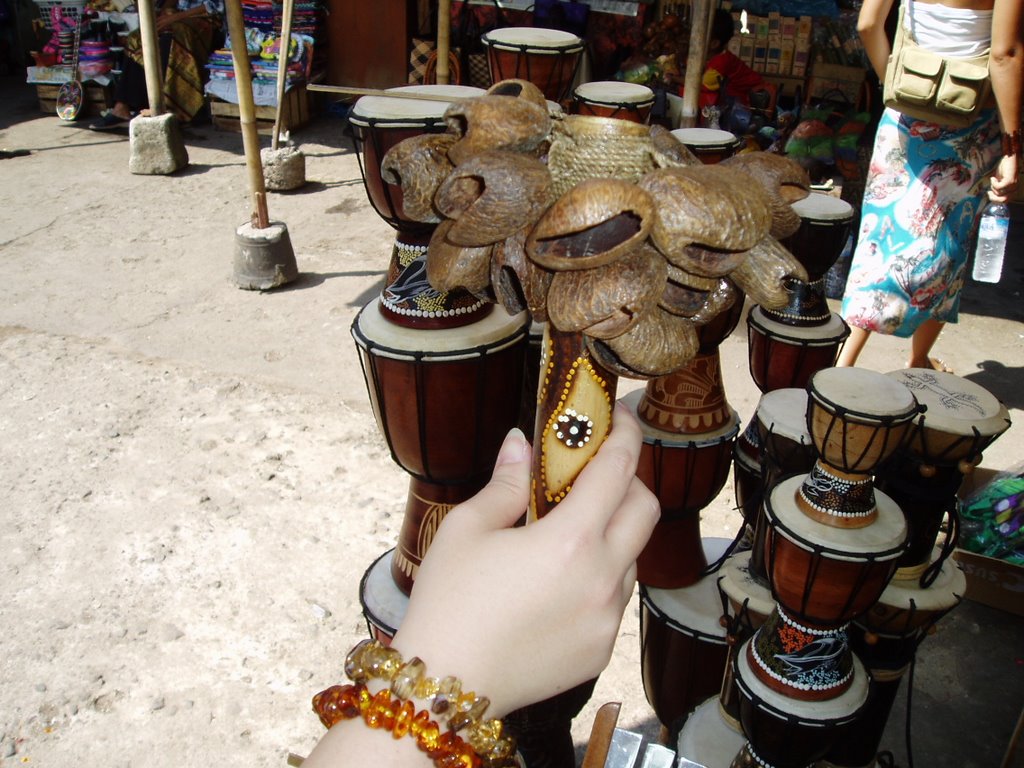
I have raved and given the highest praise to that wonderful, poisonous and yet delicious buah keluak seed but is it possible that there is still something more to this versatile food that I forgot to mention? Yes, indeed. It can be recycled and made into a musical instrument like this rattle which was spotted at the market in Ubud, the cultural and crafts center of Bali. No waste here.

I wonder what other food stuffs could be made into musical instruments. This might be made into an interesting themed menu for a restaurant where ingredients or leftovers from the main courses be later used by the resident band to make sweet melodies for the night's entertainment. It would be great. For me, it would give me a lovely excuse to play with my food.

World Food Spot 2 : Buah Keluak (Peranakan, Malaysia)

on Monday, November 13, 2006

My mother is a Nyonya, which is to say that she is part of that distinctive, historically significant and culturally rich group called the Peranakan (http://en.wikipedia.org/wiki/Peranakan). The Peranakan culture, is a lively blend of Chinese culture with the polyglot of local cultures found in the Straits of Malacca which from the 12th century onwards was a major crossroads of the spices trade. The cuisine is a similar blending of flavours with adaptations to local delicacies, fruits and vegetables. One specialty is the Buah Keluak and this has been for me, an all time favourite since childhood.

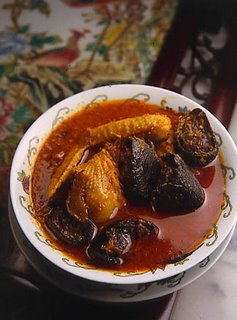
It is usually cooked together with chicken or with pork ribs to form a rich, spicy stew which is flavoured with spices and the buah keluak. Buah Keluak or the Keluak Fruit is a very special, geographically limited, rare and unusual ethnic food. It is not a fruit nor is it a nut, although it resembles a nut and is often mistaken as such. Instead it is a very toxic seed from a very toxic fruit of a very toxic tree but when properly treated and cooked, it is ambrosia. Some call it the “truffle of Asia”. I would best describe it as “savoury chocolate”. To be honest, it is like nothing else so any comparison is quite whimsical.

The Black Buah Keluak with Chicken


Buah keluak seeds come from the “football fruit” of the Kepayang tree or Pangium edule which is probably only found in Borneo, Sumatra and Malaysia. This forest tree can reach 60 m in height and has thick, waxy broad leaves. Almost every part of this tree and fruit are poisonous and in fact extract from the crushed seeds can be used to make poisoned tipped arrows. The reason for this is that the plant material is rich in cyanide or prussic acid. To prepare the seeds, they are often buried underground coated in ashes for as long as 40 days, then boiled and cleaned. This process should remove the poisons. Visit http://gardenerwork.blogspot.com/2006/10/buah-keluak.html for some good visuals of this unusual plant and its seeds.

For those who would like to try to cook this dish, I suggest you visit http://www.makansutra.com/Makanzine/Nov99/ayam_buah_keluak.html. Be warned, it is a lot of work. Once the buah keluak is prepared, a small opening needs to be created by using a cleaver. The buah keluak can then be cooked. The fleshy part should turn soft and black with a strong nutty flavour. Some master chefs insist on extracting the flesh, mixing it with a bit of meat and re-stuffing the flesh back into the seeds. This extra work ensures a more even and consistent flavour.

The cooked dish is served with rice. You would place one or two pieces of meat on a plate and liberally douse the rice with the flavourful sauce. Then take a buah keluak and using a chopstick or fork, extract the flesh from the seed. Mix the flesh with the meat, rice and sauce. Enjoy.

If served with this dish, I could easily consume up to five times my normal intake of rice because it just goes so well together. What makes this such a great culinary experience? 1. Its nutty flavour, 2. Its creamy texture, 3. Its heady aroma, 4. its rarity and uniqueness and 5. its contribution to a rich cultural history. The best way to try this is to visit Malaysia and ask around for a Peranakan restaurant or even better, befriend a Peranakan who knows the recipe and get invited home for dinner. Sorry, there isn’t any easy way to do this but it will be so worthwhile. Hurry, this great dish of my childhood is getting increasingly harder to find with each passing year and because of the rarity of the tree, this will truly remain a regional ethnic dish even in today’s global village.

You let me down, Indonesia

on Friday, October 27, 2006


If you checked in on me at my last posting, you would have found me in an officially declared funk and that was at the beginnning of what had promised to be a glorious 5 day long weekend in Malaysia on account of the Hindu festival of Diwali and the muslim festival of Eid. Well, far from being the long anticipated break with which to spend top quality time with friends and family and to hone one's blog writing skills, I instead achieved a rare state of being - that of being in a funk, in the middle of a haze and under the weather. That's my long way of telling you that I have been ill and that I make a grumpy, irritable and irritating patient.

I have been coughing for weeks because of the haze from those peat fires in Indonesia which is just blanketing parts of South East Asia. Although it was only a dry cough, it weakened my immunity and probably made me susceptible to a flu bug that was conveniently hiding amongst one of the sweet, innocent, smiling children in my friends' big broods. Sweet, innocent, smiling children are really the world's best bio-terrorists as they are able to catch with ease the newest germ out in the market and pass it on as quickly. Tag. You're it.

So with a sniffling nose and weepy eyes and a loud hacking cough, and while still delirious because of fever, I read in the local newspaper with great disdain that Indonesia's parliament was not going to agree to Indonesia signing an ASEAN Regional Transboundary Haze Agreement. They decided to try to use their haze creating fires as some sort of bargaining chips for concessions on trade and fisheries with the neighbouring countries. Imagine having a neighbour who wants the rest of the neighbourhood to pay him to get rid of his health threatening bad habits. What are these politicians thinking? How can any one seem to find any benefit from keeping this choking haze around?

When the world faced the possibility of nuclear annihiliation because of the struttings of the USA and Russia, I was deeply comforted by the song by Sting which said "the Russians love their chidren too" and which implied no one was mad enough to condemn their future generations to the horrors of nuclear fallout. Sadly, I do not see such similar stirrings of the heart amongst the Indonesian Parliamentarians who are holding in their hands the fate of millions of Indonesians and other Asians condemning them to further exposure to toxic smoke so that they can bargain their gasps for fresh air for business and trade concessions. Shame on you.

"You let me down, Indonesia.
Your peatland and forest's on fire
High toll on wildlife and on your people
but still your leaders, they want to quibble"

"You let me down, Indonesia.
You do not care for your neighbours
That much is clear, but yet we had hoped
that for the children, you'd stop the smoke."
(to be sung to the tune of "Don't cry for me, Argentina.")

Specially trained Squirrel checking on Veruca to see if she is a BAD nut. ( a scene from Charlie and the Chocolate Factory). Similar medical exam. recommended for Indonesian Parliamentarians.

Related Posts Widget for Blogs by LinkWithin